
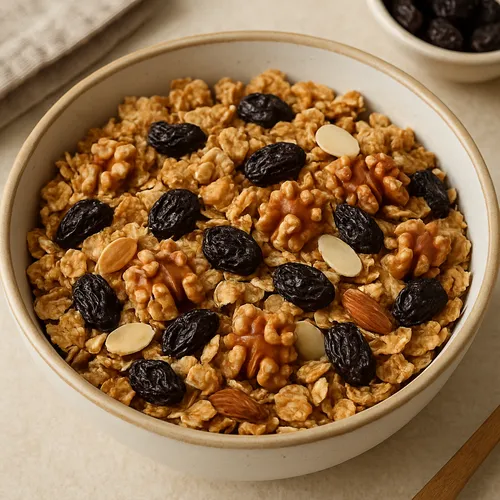
Why raisins remain central to cereal and muesli development
Breakfast cereal brands rely on raisins because they offer a consistent natural sweetness, visual appeal and a familiar eating experience for consumers of all ages. Their soft texture contrasts well with crunchy clusters, enhancing the overall sensory profile of a cereal bowl.
- Clean-label ingredient familiar to consumers
- Stable sweetness without artificial additives
- Strong visual presence in packaging and transparent pouches
- High versatility for both cold and baked cereal lines
Key specification points for cereal applications
1. Moisture balance
Cereal makers usually target a mid-moisture raisin that remains soft without causing cluster breakdown. An overly moist raisin risks absorbing or transferring moisture to crunchy elements, while raisins that are too dry can create an undesirable hardness.
2. Oil coating
To ensure smooth dosing and avoid stickiness during blending, a light oil coat (around 0.3–0.5% sunflower oil) is used. This maintains free-flowing behaviour even during high-speed mixing.
3. Piece integrity
Raisins should remain whole, clean and visually appealing. Excessively damaged pieces reduce visual consistency and may contribute to dust during blending.
4. Size consistency
Most cereal lines prefer small to medium-sized raisins for even distribution. Large sizes tend to cluster together, while very small sizes may disappear in the mix.
When to select Sultanas vs other raisin types
Turkish Sultanas are the dominant choice in cereal manufacturing due to their colour stability, mild flavour and predictable moisture behaviour. Darker raisins may be used in specialty or “artisan-inspired” blends, but Sultanas remain the industry standard.
How raisins behave in baked granola vs cold mixes
Baked granola lines
In traditional baked granola, raisins may be added after baking to prevent caramelisation or colour loss. When added before baking, moisture migration must be carefully controlled.
Cold muesli blends
For unbaked mixes, the main concerns are flowability, cleanliness and moisture balance. Uniform raisins help keep mixing times short and reduce segregation during packaging.
Packaging formats preferred by cereal manufacturers
- 10 kg cartons for medium-to-large production runs
- 12.5 kg cartons for high-speed mixing lines
- 5 kg cartons for premium small-batch facilities
Poly-lined cartons preserve moisture and prevent flavour absorption from the environment. Consistent pallet patterns also support automated depalletizing systems.
Best storage practices for cereal-focused raisins
- Store between 8–15°C to maintain softness
- Keep away from humidity and heat sources
- Use FIFO rotation to maintain freshness
- Ensure cartons have adequate ventilation to prevent condensation
Summary for cereal & muesli buyers
Good raisins create balance: a natural sweetness that complements crunch, a soft chew that improves the overall bowl experience, and reliable performance in automated production environments. By choosing the correct moisture level, oil coating and grade, cereal manufacturers can ensure consistency from batch to batch.
Atlas Dried Fruits & Nuts supports cereal producers globally with tailored raisin specifications and flexible mixed-container shipment options.