
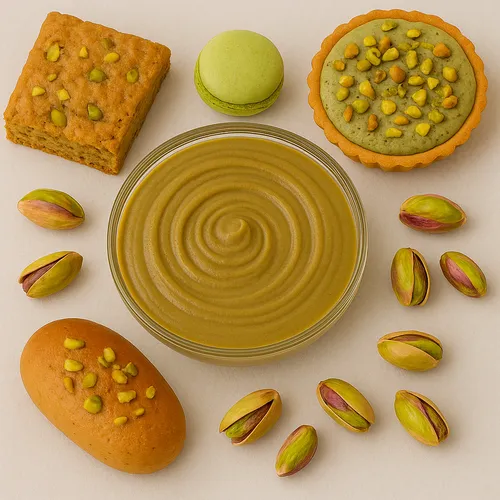
Why pistachio paste is so important in premium applications
Pistachio paste carries the aroma, color and flavor intensity of the nut itself, making it one of the most influential ingredients in specialty spreads, patisserie fillings and gelato bases. High-quality pastes offer:
- Natural bright green color for premium visual appeal.
- Strong roasted or natural pistachio aroma, depending on roast level.
- Smooth texture for even distribution in creams and fillings.
- Clean-label positioning when made from 100% pistachios.
Industrial producers depend on paste consistency to achieve uniform product lines across thousands of units.
Different grades of pistachio paste for industrial use
Turkish manufacturers typically offer several paste categories, each designed for a specific purpose.
1. Pure pistachio paste (100% pistachios)
The cleanest, most intense option. Used in:
- Premium spreads
- Artisan gelato bases
- Luxury patisserie creams
- High-end confectionery fillings
Color varies from bright green (from deep green kernels) to olive green (from standard kernels).
2. Semi-pure pistachio paste
Contains pistachios blended with small amounts of vegetable oil or sweeteners to adjust viscosity, color or cost. Common in:
- Mid-tier bakery fillings
- Chocolate centers
- Nut-based cream formulations
3. Pistachio-flavored pastes
Designed for price-sensitive applications where a pistachio profile is desired but high kernel content is not required. Often used in:
- Large-scale bakery operations
- Mass-market spreads
- Confectionery decorations
These pastes vary widely, so buyers should request detailed composition declarations.
Key specifications buyers should define
Pistachio paste performance depends on several measurable characteristics. Bulk buyers typically specify:
- Roast level — light for gelato and spreads; medium or strong for bakery fillings.
- Color grade — influenced by kernel selection (bright green to natural green).
- Fat content — affects mouthfeel and interaction with chocolate or butter-based systems.
- Particle size — finer grind gives smoother texture; slightly coarse grind adds character.
- Viscosity — critical for production lines using pumps or dosing machines.
Having a fixed specification helps maintain year-round consistency even when raw material crops differ.
How pastes are used in spreads and fillings
Pistachio pastes act as both a flavor carrier and a colorant in modern pastry and spread formulations. Manufacturers commonly use them in:
- Nut-based spreads blended with sugar, cocoa butter or vegetable oil.
- Filled biscuits requiring stable baking performance.
- Patisserie creams where smoothness and natural color are essential.
- Chocolate pralines needing intense flavor in small doses.
Using high-purity paste helps brands achieve a premium taste without artificial flavorings.
Pistachio paste in gelato and frozen desserts
Gelato producers pay particular attention to color stability and aroma persistence. Bright green paste is often preferred, though some artisan makers choose a more natural olive tone for authenticity.
Important technical considerations include:
- Emulsification behavior with dairy or plant-based bases.
- Sugar interaction and freezing-point influence.
- Fat compatibility to avoid grainy textures.
Packaging formats for bulk pistachio paste
Common industrial formats include:
- 5 kg or 10 kg tins — ideal for confectionery and gelato makers.
- Vacuum-sealed bags in cartons — help preserve color and aroma.
- Plastic pails — practical for bakeries with high usage rates.
Buyers should always confirm storage temperature (usually cool and dark), as pastes can oxidize or separate if stored improperly.
Summary
Pistachio pastes are among the most versatile and influential nut ingredients in the food industry. Their color, viscosity and flavor intensity make them essential for spreads, fillings, bakery applications and frozen desserts. By defining clear specifications and choosing the right grade, buyers can ensure consistent, high-performing results across all product lines.
Atlas provides pure and customized pistachio pastes suitable for premium and mainstream manufacturing needs, with flexible bulk packaging and year-round supply options.